
Changing postgresql.conf from a script

By Greg Sabino Mullane
August 10, 2011

Image by “TheBusyBrain” on Flickr
The modify_postgres_conf script for Postgres allows you to change your postgresql.conf file from the command line, via a cron job, or any time when you want to automate the process.
Postgres runs as a background daemon. The configuration parameters it runs with are stored in a file named postgresql.conf. To change the behavior of Postgres, one must usually edit this file, and then tell Postgres that you have made the changes. Sometimes all that is needed is to ‘HUP’ or reload Postgres. Most changes fall into this category. Other changes require a full restart of Postgres, which entails disconnecting all current clients.
Thus, to make a change, one must edit the file, find the item to change (the file consists of “name = value” lines), change it, then send a signal to the main Postgres process so it picks up the change. Finally, you should …
database perl postgres tools
Remove specific CGI variables using Apache

By David Christensen
August 10, 2011
Sometime you need to remove a single CGI variable from a query string in your published URLs; for instance, one of our client’s site had gotten spidered with a session id in the generated links, so we wanted to ensure that those URLs would be appropriately updated when re-spidered. Apache’s mod_rewrite to the rescue!
The following snippet serves to rewrite any URL which has a query string parameter named id to one the exact same without that CGI variable. Since mod_rewrite uses PCRE, we can use this to our advantage by using \b word break anchors to ensure we’re only picking up a CGI variable named exactly the same, so (say) id=bar will be removed but tid=foo will pass on through the rewrite unaltered.
# already assume RewriteEngine on

RewriteCond %{QUERY_STRING} ^(.*)\bid=(\w*)\b(.*)
RewriteRule (.*) $1?%1%3 [R=301,L]
Note in the above example that we know the range of values that was present for the id variable, so \w is sufficient to determine the full value to remove in this case. $N is the replacement from the Nth RewriteRule group and %N is the replacement from the Nth RewriteCond group. We use [R=301] to trigger an external 301 redirect, which search engines should see as …
ecommerce sysadmin tips tools
The rails_admin gem in Ecommerce

By Steph Skardal
August 9, 2011
Update: Since writing this article, this gem has had several updates. All rails_admin configuration now must be pulled out of ActiveRecord models and into the initializer. The look and feel has also been updated. Read about it more here. Additionally, End Point has released a Ruby on Rails Ecommerce Engine with a sleek admin interface driven by rails_admin. Read more about it here.
I recently installed the rails_admin gem into a new Rails project. This particular site is currently running on Interchange, but it is not an ecommerce business, so Interchange is overkill for the site. The client has recently decided to make the switch to Rails (and DevCamps) with our help, and they have a moderate budget to do so. For the first increment, we considered installing phpMyAdmin for them to work directly with the data until a nice admin interface was built, but instead I spent a bit of time installing the rails_admin gem which has been on my mind for the last 6 months. The result: I’m extremely impressed with what rails_admin has to offer.
To show some examples of rails_admin in action, I’ll use the data model from a Sinatra ecommerce setup I recently wrote about, because it has a basic …
ecommerce ruby rails sinatra
Rails Optimization: Digging Deeper
By Steph Skardal
August 5, 2011
I recently wrote about raw caching performance in Rails and advanced Rails performance techniques. In the latter article, I explained how to use a Rails low-level cache to store lists of things during the index or list request. This technique works well for list pages, but it doesn’t necessarily apply to requests to an individual thing, or what is commonly referred to as the “show” action in Rails applications.
In my application, the “show” action loaded at ~200 ms/request with low concurrency, with the use of Rails fragment caching. And with high concurrency, the requests shot up to around 2000 ms/request. This wasn’t cutting it! So, I pursued implementing full-page caching with a follow-up AJAX request, outlined by this diagram:
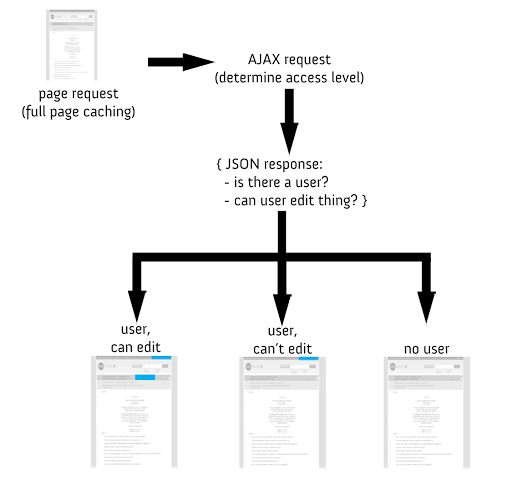
First, the fully-cached is loaded (quickly). Next, an AJAX request is made to retrieve access information. The access information returns a JSON object with information on whether or not there is a user, and if that user has edit access to that thing. If there is no user, the page stays as is. If there is a user, but he does not have edit permissions, the log out button is shown and the username is populated. If there is a user and he has edit …
javascript performance rails
DevCamps news

By Jon Jensen
August 4, 2011
DevCamps is a system for managing development, integration, staging, and production environments. It was developed by End Point for, and with the help of, some of our ecommerce clients. It grew over the space of several years, and really started to become its own standalone project in 2007.
Camps are a behind-the-scenes workhorse of our web application development at End Point, and don’t always get much attention because everyone’s too busy using camps to get work done! But this summer a few things are happening.
In early July we unveiled a redesign of the devcamps.org website that features a more whimsical look, a better explanation of what camps are all about, and endorsements by business and developer users. Marko Bijelic of Hipinspire did the design. Take a look:

In less than two weeks, on August 17, I’m going to be giving a talk on camps at YAPC::EU in Riga, Latvia. YAPC::EU is Europe’s annual Perl conference, and will be a nice place to talk about camps.
Many Perl developers are doing web applications, which is camps’ main focus, so that’s reason enough. But camps also started around the Interchange application server, which is written in Perl. And the camp …
camps conference perl open-source
Debian Postgres readline psql problem and the solutions
By Greg Sabino Mullane
August 2, 2011

There was a bit of a controversy back in February as Debian decided to replace libreadline with libedit, which affected a number of apps, the most important of which for Postgres people is the psql utility. They did this because psql links to both OpenSSL and readline, and although psql is compatible with both, they are not compatible with each other!
By compatible, I mean that the licenses they use (OpenSSL and readline) are not, in one strict interpretation, allowed to be used together. Debian attempts to live by the letter and spirit of the law as close as possible, and thus determined that they could not bundle both together. Interestingly, Red Hat does still ship psql using OpenSSL and readline; apparently their lawyers reached a different conclusion. Or perhaps they, as a business, are being more pragmatic than strictly legal, as it’s very unlikely there would be any consequence for violating the licenses in this way.
While libreadline (the library for GNU readline) is a feature rich, standard, mature, and widely used library, libedit (sadly) is not as developed and has some important bugs and shortcomings (including no home page, apparently, and no Wikipedia page!). This …
open-source postgres
Cuenca, Ecuador

By Benjamin Goldstein
July 28, 2011
Given that End Point uses a distributed office structure and that I do almost all of my work online, in theory I should be able to work just about anywhere there’s a good Internet connection. That sounds neat, but is it in fact true? Well, earlier this year I put the theory to a serious test. By nature I’m not all that adventurous a traveller, but my wife is, and she’s fluent in Spanish. Our teenage sons are going to be grown men all too soon, so if we were ever to take the plunge into living abroad as a family, I realized it was now or never.
In looking for a place to go we had some criteria:
- a safe place in Latin America without an excess of walls
- good or at least reasonable Internet connectivity
- soccer training for our 15-year-old
- high school in Spanish for our 16-year-old.
We are very lucky that my friend Tovias suggested his home town (more or less) and volunteered his family to look after us there!
So, in February I picked up and relocated with my family to Cuenca, Ecuador, for just over three months. I worked. My wife, Gina, homeschooled one of our sons, and generally kept us all going in this beautiful and historical city.
company travel remote-work
Company Presentation: jQuery and Rails
By Steph Skardal
July 27, 2011
Yesterday, I gave a company presentation on jQuery and Rails. The talk covered details on how jQuery and Rails work together to build rich web applications, with a considerable amount of focus on AJAX methods. Check out the slides here:
One piece of knowledge I took away from the talk is how different the Rails 3 approach is for unobtrusive AJAX behavior using helpers like link_to_remote and remote_form_for. Mike Farmer made a recommendation to read the rails.js source here to see how onclick behavior is handled in Rails 3.
javascript jquery ruby rails