
Web Security Services Roundup

By Phineas Jensen
September 19, 2017
Security is often a very difficult thing to get right, especially when it’s not easy to find reliable or up-to-date information or the process of testing can be confusing and complicated. We have a lot of history and experience working on the security of websites and servers, and we’ve found many tools and websites to be very helpful. Here is a collection of those.
Server-side security
There are a number of tools available that can scan your website to check for common vulnerabilities and the quality of SSL/TLS configuration, as well as give great tips on how to improve security for your website.
- Qualys SSL Labs Server Test takes a simple domain name, performs a series of tests from a variety of clients, and returns a simple letter grade (from A+ down to F) indicating the quality of your SSL/TLS configuration, as well as a detailed summary for a host of configuration options. It covers certificates key and algorithms; TLS and SSL configurations; cipher suites; handshakes on a wide variety of platforms including Android, iOS, Chrome, Firefox, Internet Explorer and Edge, Safari, and others; common protocols and vulnerabilities; and other details.
- HTTP Security Report does a similar …
browsers hosting security tls sysadmin
Client Case Study: Vervante—Publishing, Production and Fulfillment Services

By Greg Hanson
August 28, 2017
A real-life scenario
The following is a real-life example of services we have provided for one of our clients.
Vervante Corporation provides a print on demand and order fulfillment service for thousands of customers, in their case, “Authors”. Vervante needed a way for these authors to keep track of their products. Essentially they needed an Inventory management system. So we designed a complete system from the ground up that allows Vervante’s authors many custom functions that simply are not offered in a pre-built package anywhere.
This is also a good time to mention that you should always view your web presence, in fact your business itself, as a process, not a one time “setup”. Your products will change, your customers will change, the web will change, everything will change. If you want your business to be successful, you will change.
Some Specifics
While it is beyond the scope of this case study to describe all of the programs that were developed for Vervante, it will be valuable for the reader to sample just a few of the areas to understand how diverse a single business can be. Here are a few of the functions we have built from scratch, over several years to continue to …
case-study clients ecommerce interchange
Custom eCommerce Development
By Greg Hanson
August 28, 2017
“Custom eCommerce” means different things to different people and organizations. For some eCommerce shopping cart sites that pump out literally hundreds of websites a year, it may mean you get to choose from a dizzying array of “templates” that can set your website apart from others.
For others, it may be a slightly more involved arrangement where you can “create categories” to group display of your products on your website … after you have entered your products into a prearranged database schema.
There are many levels of “custom” out there. Generally speaking, the closer you get to true “custom”, the more accurate the term “development” becomes.
It is very important for your business that you decide what fits your needs, and that you match your needs to a platform or company that can provide appropriate services. As you can imagine, this will depend entirely on your business.
Example scenarios
For example, a small one- or two-person business that does fulfillment of online orders may be well suited for a pre-built approach, where you pay a monthly fee to simply log into an admin, add your products, and some content, and the company does the rest. It handles all of the …
ecommerce
How to split Git repositories into two

By Wojtek Ziniewicz
August 14, 2017
Ever wondered how to split your Git repo into two repos?
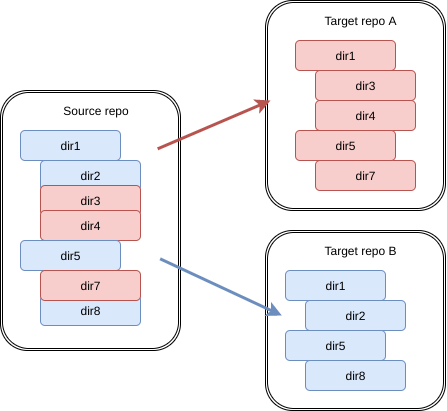
First you need to find out what files and directories you want to move to separate repos. In the above example we’re moving dir3, dir4, and dir7 to repo A, and dir1, dir2, dir5, and dir8 to repo B.
Steps
What you need to do is to go through each and every commit in git history for every branch and filter out commits that modify directories that you dont care about in your new repo. The only flaw of this method is that it will leave those empty, filtered out commits in the history.
Track all branches
First we need to start tracking all branches locally:
for i in $(git branch -r | grep -vE "HEAD|master" | sed 's/^[ ]\+//');
  do git checkout --track $i
done
Then copy your original repo to two separate dirs: repo_a and repo_b.
cp -a source_repo repo_a
cp -a source_repo repo_b
Filter the history
Following command will delete all dirs that exclusively belong to repo B, thus we create repo A. Filtering is not limited to directories. You can provide relative paths to files, dirs etc.
cd repo_a
git filter-branch --index-filter 'git rm --cached -r dir8 dir2 || true' -- --all

cd repo_b
git filter-branch …
git
How to check process duration in Linux with the “ps” command

By Muhammad Najmi bin Ahmad Zabidi
August 8, 2017
In certain cases we might want to get a certain process’ elapsed time for our own reason. Turns out “ps” command could easily assist us in that. According to “ps” manual, etime could put the duration of time in [[DD-]hh:]mm:ss. format, while etimes in seconds.
From “ps” manpage:
etime       ELAPSED   elapsed time since the process was started, in the form [[DD-]hh:]mm:ss.
etimes      ELAPSED   elapsed time since the process was started, in seconds.
To use that, we could use (in [[DD-]hh:]mm:ss. format):
ps -p "pid" -o etimeor in seconds:
ps -p "pid" -o etimesIn this case the “pid” should be replaced with your intended process ID.
The following will help to nicely reporting the output. We can put -o etime or -o etimes with other argument, that is “command”, in order to show the executed command along with its very own absolute path:
ps -p "28590" -o etime,commandELAPSED COMMAND
21:45 /usr/bin/perl ./fastcgi-wrapper.pl 7999We can also get the start date of the process’ execution:
najmi@ubuntu-ampang:~$ ps -p 21745 -o etime,command,start
    ELAPSED COMMAND                      STARTED
 1-19:47:45 /usr/lib/firefox/firefox      Aug 02
What if we do not …
shell linux
JBoss 4/5/6 to Wildfly migration tips

By Piotr Hankiewicz
July 31, 2017

Introduction
Recently, we have taken over a big Java project that ran on the old JBoss 4 stack. As we know how dangerous for a business is outdated software, we and our client agreed that the most important task is to upgrade the server stack to the latest WildFly version.
It’s definitely not an easy job, but it’s worth to invest to sleep well and don’t worry about software problems.
This time it was even more work because of a complicated and not documented application, that’s why I wanted to share some tips and problem resolutions for issues I encountered.
Server configuration
You can set it up using multiple configuration files in the standalone/configuration directory.
I can recommend to use the standalone-full.xml file for most of setup, it contains a default full stack as opposed to standalone.xml.
You can also set up an application specific configuration using various configuration XML files (https://docs.jboss.org/author/display/WFLY10/Deployment+Descriptors+used+In+WildFly). Remember to keep the application specific configuration in the Classpath.
Quartz as a message queue
The Quartz library was used as a native message queue in previous JBoss versions. If you struggle …
java
co:collective Doable Innovation Software

By Elizabeth Garrett Christensen
July 26, 2017
co:collective is a growth accelerator that works with leadership teams to conceive and execute innovation in the customer experience using a proprietary methodology called StoryDoing.
Doable, one of co:collective’s recent innovations, is a cloud-based platform designed to empower employees to meaningfully contribute and collaborate on ideas that move their business forward. The tool allows companies to solicit ideas from employees at all levels of an organization, filter down those ideas, make decisions as a team, and then implement a project—all the while collaborating in a fun and easy-to-use application. Over 200 companies across multiple sectors use Doable to create new products, new features, and problem solve to keep their business growing.
co:collective engaged End Point’s front-end developer Kamil Ciemniewski to work with their in-house development team led by Tommy Dunn. Kamil joined the Doable effort to refactor the Doable application which was moving from a classic Ruby on Rails-based application to an Angular frontend application with a Ruby on Rails backend. Kamil has been working with Doable since March to complete the application re-write and the project has gone …
case-study clients
Postgres migrating SQL_ASCII to UTF-8 with fix_latin

By Greg Sabino Mullane
July 21, 2017

Upgrading Postgres is not quite as painful as it used to be, thanks primarily to the pg_upgrade program, but there are times when it simply cannot be used. We recently had an existing End Point client come to us requesting help upgrading from their current Postgres database (version 9.2) to the latest version (9.6—but soon to be 10). They also wanted to finally move away from their SQL_ASCII encoding to UTF-8. As this meant that pg_upgrade could not be used, we also took the opportunity to enable checksums as well (this change cannot be done via pg_upgrade). Finally, they were moving their database server to new hardware. There were many lessons learned and bumps along the way for this migration, but for this post I’d like to focus on one of the most vexing problems, the database encoding.
When a Postgres database is created, it is set to a specific encoding. The most common one (and the default) is “UTF8”. This covers 99% of all user’s needs. The second most common one is the poorly-named “SQL_ASCII” encoding, which should be named “DANGER_DO_NOT_USE_THIS_ENCODING”, because it causes nothing but trouble. The SQL_ASCII encoding …
postgres unicode perl