
Install Pentaho BI Server 4.8 Community Edition with PostgreSQL Repository

By Selvakumar Arumugam
November 7, 2013
Pentaho BI server community edition can be installed through an archive file available from SourceForge.
Prerequisites
- Java 6
- PostgreSQL
Download Pentaho BI Server installation file (biserver-ce-4.8.0-stable.zip) from SourceForge: http://sourceforge.net/projects/pentaho/files/Business%20Intelligence%20Server/4.8.0-stable
Unzip the archive file and navigate inside biserver-ce to set sh files to executable mode:
$ unzip biserver-ce-4.8.0-stable.zip
$ cd biserver-ce
$ find . -type f -iname '*.sh' -exec chmod a+x {} \;
Pentaho community edition uses hsql database as default. Need to create two databases in Postgres for Pentaho. Find the SQL files to create databases under biserver-ce/data/postgresql. database_name, user_name and password are configurable through SQL files. Fix two errors before creating database using SQL files. Comment two lines in below files tables as commented.
- create_quartz_postgresql.sql
ALTER TABLE qrtz_fired_triggers
    ALTER TRIGGER_NAME  TYPE VARCHAR(200),
    ALTER TRIGGER_GROUP TYPE VARCHAR(200),
    ALTER INSTANCE_NAME TYPE VARCHAR(200),
    ALTER JOB_NAME      TYPE VARCHAR(200),
    ALTER JOB_GROUP     TYPE VARCHAR(200),
    ADD COLUMN …
analytics pentaho postgres casepointer
Install Pentaho BI Server 5 Enterprise Edition with PostgreSQL repository
By Selvakumar Arumugam
November 7, 2013
Pentaho provides different ways to install Pentaho BI server. Each method has its own flexibility in installation.
-
Installer mode—Easy to install BA & DI server & tools in one flow with default PostgreSQL repo & default Tomcat server. (New Postgres installed on port 5432.)
-
Archive mode—BA server installed with own BA repository & default Tomcat server. Necessary tools need to be installed manually.
-
Manual mode—BA server installed with own BA repository & own application server (Tomcat or JBoss). Necessary tools need to installed manually.
We have a Postgres instance running on our server and are good with Tomcat as application server so Archive mode of installation is suitable for us. Pentaho installation requires two things be installed before starting with Pentaho installation.
- Java 7
- PostgreSQL
Archive mode installation files can be accessible only to license purchased users. Download biserver-ee-5.x-dist.zip from Pentaho customer portal with account credentials here: https://support.pentaho.com/forums/20413716-Downloads
Unzip the archive file and you can see the installation files inside extracted directory.
$ unzip biserver-ee-5.x-dist.zip
$ cd …
analytics pentaho postgres casepointer
Specify versions for your dependencies in your Gemfiles

By Kamil Ciemniewski
November 7, 2013
How often have you been too lazy to put a version spec for gems you depended on in your projects? Do you fear updating the gems your app uses in production?
Here is an elusive-obvious tip for you: Always specify version numbers for your dependencies in your app’s Gemfile.
Version specs should:
-
be strict numbers for very fragile gems like Rails
-
use the pessimistic operator for others (with ~>)
Updating apps with versionless Gemfiles is painful
Newer gem versions often break compatibility. That makes updating a disaster if you don’t have any restrictions in place for your dependencies.
We should coin a new term in the field of psychology: Update Anxiety.
That’s precisely the state the vast majority of us is in when proceeding to update dependencies in our projects.
In Rails, having a versionless Gemfile makes clean updates impossible.
Fearing the update makes your app susceptible to bugs
Newer versions of gems are there, not only for delivering new features. The history of changes between different versions mostly show changes related to bug fixes. If you see a gem which mostly delivers new features without fixing bugs—stay away from it!
If you do not update the gem set out …
ruby rails
Installing CentOS 5 on a 3 TB Drive

By Cas Rusnov
November 6, 2013
In collaboration with Spencer Christensen and Lele Calo.
The everyday problem: Set up a remotely-hosted machine with a 3 TB drive.
The bigger problem: It must be CentOS 5.
While this would be a trivial task with a newer OS, CentOS 5 only supports MBR style partitioning, which itself only supports drives less than 2 TB in size; well let us be clear, the installer and GRUB shipped with the installation disk only support MBR normally, the kernel supports the GPT format. GPT is a newer partition format that was introduced by EFI standard, which can support booting from large devices. From various documents and postings on the internet it seemed possible to still use MBR with more than 2TB, but in practice this turned out to be completely unsuccessful. So we moved on with a plan to use GPT.
Since the CentOS 5 installer cannot work with GPT partition tables, we needed to use something else to create the partitions we wanted. We did this by using a rescue CD, like SystemRescue CD from here http://www.sysresccd.org/Download.
-
Boot into the rescue CD
-
Use gdisk to first delete the old partition table to make sure you start cleanly.
- gdisk, then x (for extended commands), then z to delete. …
redhat devops
Slony Migration experience version 1.2 to version 2.2

By David Christensen
November 6, 2013
We recently had a client who upgraded from Slony 1.2 to Slony 2.2, and I want to take this opportunity to report on our experiences with the migration process.
A little background: This client has a fairly large database (300GB) replicated across 5 database nodes, with the slon daemons running on a single shared box. We wanted to upgrade to the latest Slony 2 version for stability and to resolve some known and unresolvable issues with the 1.2 branch of Slony when replication lags a specific amount.
As is usual for any large migration projects such as this, we had to deal with a set of tradeoffs:
-
Firstly, minimize any necessary downtime.
-
Secondly, allow for rollback due to any discovered issues.
-
Thirdly, ensure that we have sufficient redundancy/capacity whichever final state we were to end up in (i.e., successful migration to Slony 2 or reversion to Slony 1.2).
We of course tested the process several times in order to ensure that the processes we came up with would work and that we would be well-equipped to handle issues were they to arrive.
The upgrade from Slony 1.2 to Slony 2.2 necessarily requires that we uninstall the Slony 1.2 system and triggers from the indicated …
postgres replication
SELinux and the need of talking about problems

By Emanuele “Lele” Calò
November 5, 2013
It’s known common sense that when there’s a problem you should talk about it
Well sometimes it seems like SELinux doesn’t agree, so that it quietly blocks your software and silently fail.
In this case the issue with SELinux is that since it’s usually a very talkative type of software (through /var/log/audit/auditd.log and sometimes /var/log/messages), the poor busy system administrator would kinda take it for granted that when there will be a problem SELinux will shout it out as usual.
Unfortunately that’s not the case if the permission/property involved has the dontaudit setting applied.
So a quick solution is to temporarily set SELinux to “permissive” so to check that it is actually causing the problem; basically if your script works after setting SELinux to permissive and stops again when resetting to enforce, then you’re on the good path to find your solution.
The next step would be to temporarily disable dontaudit settings with
semodule -DBAnd then start to manually collect all the failing rules related to your problem and crafting a new custom SELinux module with these.
After finishing creating your module, follow your usual SELinux pluggable module management workflow and …
redhat selinux
jQuery contents() method

By Steph Skardal
November 4, 2013
I had an interesting JavaScript challenge recently and came across a jQuery method that I hadn’t heard of before, so I wanted to share my experience. Given the following markup, I needed a way to hide all the text not inside span.highlighted elements:
<p>Here is some text.
<span class="highlighted">Here is more text! </span>
Here is even more text! Here is some more un-wrapped text.
<span class="highlighted">Here is another wrapped span.</span>
</p>
With standard CSS rules like visibility, display, and opacity, there’s not an easy way to hide only the unhighlighted text without additional HTML modifications. So, I set out to wrap the unhighlighted text in additional HTML elements dynamically, to produce the following markup from our example:
<p><span class="unhighlighted">Here is some text. </span>
<span class="highlighted">Here is more text! </span>
<span class="unhighlighted">Here is even more text! Here is some more un-wrapped text. </span>
<span class="highlighted">Here is another wrapped span.</span>
</p>
With the markup above, the …
javascript jquery
ASTC Day 1

By Bianca Rodrigues
October 31, 2013
I recently attended ASTC—Association of Science Technology Centers in Albuquerque, New Mexico (also known as Breaking Bad territory). I was amazed by the interactive and unique exhibits I encountered, as well as the cool museums and science centers that attended.
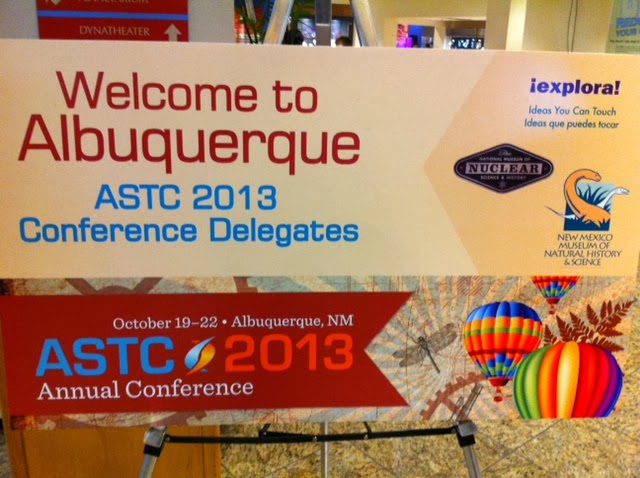
On Day 1 we had a full day of sessions geared towards empowering museum directors and exhibit designers to create meaningful exhibits in order to engage their visitors.
As many of you know, End Point has installed our Liquid Galaxy display platform at several museums throughout the country and world, at places like the Ann Arbor Hands-On Museum, the San Jose Tech Museum and the Smithsonian Institution. Our experience working with museums has been absolutely positive thus far, so we wanted to meet others within the industry to not only promote the Liquid Galaxy further, but also learn how to expand our offerings for our museum clients.
One of the best sessions I attended was called Gaming in Museums to Engage Audiences. Experts from the Science Museum of Minnesota, Carnegie Science Center and the American Museum of Natural History all shared how they have utilized gaming experiences to enhance the visitor experience at …
conference visionport