
Announcing Youth Town Hall — a new civic platform

By Ben Ironside Goldstein
October 5, 2026
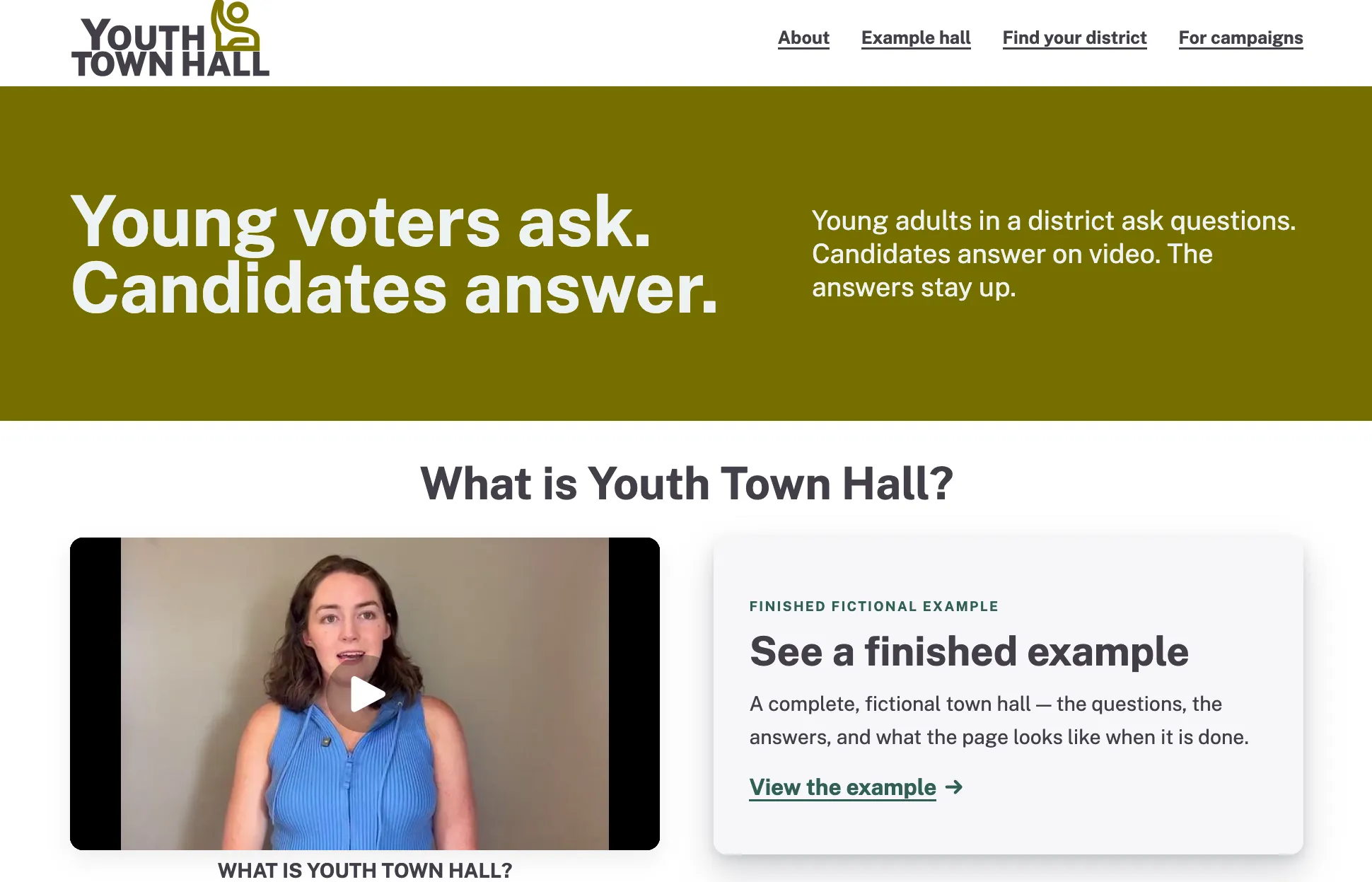
We’re proud to announce Youth Town Hall, a nonpartisan platform where political candidates can connect with constituents ages 18–35. Each town hall gives young adults a focused place to submit questions and watch candidates’ video responses—without ads, algorithmic feeds, or vitriolic commentary.
We developed Youth Town Hall with the people behind the Presidential Youth Debates, which organized debates among U.S. presidential candidates—including Bill Clinton, Bob Dole, George W. Bush, John Kerry, Ralph Nader, Barack Obama, and John McCain—from 1996 to 2012.
Those events invited young people to help shape the conversation rather than simply watch it: youth-submitted questions, informed by a broad network of civic, educational, and media partners, were put directly to presidential contenders. Youth Town Hall carries that basic idea forward in a format built for participation across distance and schedules.
Connecting young voters with candidates remains important, but today’s media environment often works against sustained attention. Much political outreach happens by text, email, and social media. These channels can reach many people, but their messages arrive amid countless other demands for attention. Abuse on the same platforms can also make political participation feel hostile or exhausting. Many young people have begun to turn away from social media.
Youth Town Hall offers another approach. Campaigns can direct young constituents to a simple, focused town hall page, where visitors submit questions and candidates upload video answers to those they select. Each response includes captions and a transcript and can be shared.
For people submitting questions, the process is intentionally straightforward. After submitting a question, they can manage it and choose whether their name appears. The campaign reviews the submissions and selects the questions the candidate will answer, but cannot edit the wording. When a response is published, the submitter can be notified. The finished page keeps the original question beside the video, captions, and transcript.
The asynchronous format gives both sides more room than a live event. Young people do not need to be in the same room — or free at the same moment — to participate, and candidates can answer with enough time and context to be useful. Because the responses remain available and shareable, the exchange can reach people well beyond the original submitter.
We believe that technology can help young Americans raise their voices, but it should be the right technology. Youth Town Hall combines the positive aspects of the internet with old-school, local-politics ethos.
We designed the service to collect little data about participants. Email addresses are used only to verify submissions, let people manage their questions — including making them anonymous later — and notify them when an answer is published. Campaigns do not receive those addresses, and they are not used for marketing or political outreach. Campaigns decide which questions to answer, so trolls have no impact.
Because Youth Town Hall was developed as a partnership, End Point helped shape the product as well as build it. Eleven End Pointers collaborated over this past summer, drawing on more than 30 years of experience building secure, scalable systems.
That meant solving more than video recording and playback. We brought question submission and campaign review, email verification and notifications, captions and transcripts, privacy controls, and long-term hosting into one coherent workflow. Each town hall runs on its own server, and considerable effort went into making the platform reliable, secure, and private.
Although we built Youth Town Hall for civic engagement, the same model can serve organizations that need a focused, privacy-conscious place to collect questions and publish video responses. Associations, institutions, and community groups could use it for leadership Q&As, member updates, public information, or other exchanges where thoughtful questions deserve substantive answers. We’re interested in exploring those uses too.
The engineering serves a mission we care about. Young voters should have a straightforward way to ask candidates serious questions and hear their answers without an algorithm deciding what deserves attention. Youth Town Hall is a piece of civic infrastructure: a focused place for direct, good-faith exchange, with enough room for candidates to answer in context. It cannot repair political discourse on its own, but we believe building better conditions for informed participation is useful work, worth doing well.
We’ve opened Youth Town Hall for the 2026 U.S. election cycle, culminating in Election Day on November 3. But this election is just the beginning. We look forward to offering the platform for post-election town halls with elected representatives and future elections — giving young people an ongoing way to ask questions and hear directly from those who serve them.
Comments