
Creating custom dictionaries with the Forgery gem

By Kevin Campusano
August 28, 2026

When it comes to generating fake data for testing (or any other purpose), most Rails projects nowadays use the Faker gem. With a simple function call, you can generate a random name, email, telephone number, etc.
However, if you’re still using the Forgery gem, there’s a neat trick that it has up its sleeve that, even though Faker can also do it, I’d say it feels more natural with Forgery: creating custom dictionaries. That is, defining a custom list of values and having the gem use that list as its data source.
This might be useful when you want to generate random-ish data, but want to limit the possible values.
In this short and sweet blog post, I show you how.
First, we add the gem to our Gemfile:
gem "forgery", ">= 0.8.1"Then, we run its generator:
bundle exec rails generate forgeryThis generates a directory structure under lib which serves as the foundation for our customizations:
lib
└── forgery
    ├── dictionaries
    ├── extensions
    ├── forgeries
    └── formats
Under lib/forgery/dictionaries we will put a raw text file with the list of words that we want our custom dictionary to contain. Under lib/forgery/forgeries we will put the Ruby class through which our code will be able to access the dictionary.
For example, here’s a dictionary of countries in the Caribbean. We store this in lib/forgery/dictionaries/caribbean_countries:
Antigua and Barbuda
Bahamas
Barbados
Cuba
Dominica
Dominican Republic
Grenada
Haiti
Jamaica
Saint Kitts and Nevis
Saint Lucia
Saint Vincent and the Grenadines
Trinidad and Tobago
And the forgery class looks like this:
# lib/forgery/forgeries/address.rb

# The important detail is to inherit from "Forgery"
class Forgery::Address < Forgery
  def self.caribbean_country
    # caribbean_countries should match the name of the file from which we want
    # to fetch values. This file must exist under lib/forgery/dictionaries.
    dictionaries[:caribbean_countries].random
  end
end
Of course, the name of the class and the method can be anything. The important detail is that our custom class needs to inherit from the Forgery class and that the name we pass to the dictionaries method needs to match the file we created under lib/forgery/dictionaries.
With that done, we can now call our forgery like so:
Forgery('address').caribbean_country

# or

Forgery::Address.caribbean_country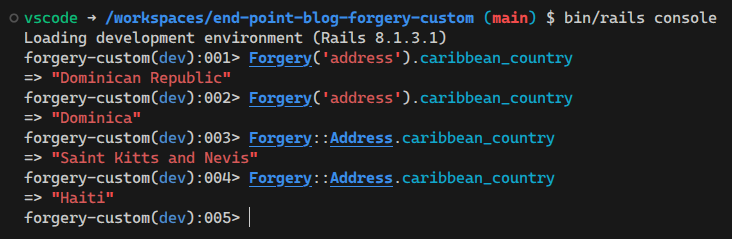
And that’s all for now! We recently used this technique in a legacy project to help implement a feature where random, human-friendly Wi-Fi passwords had to be auto-generated for newly onboarded users. Pretty neat!
Comments